Introduction
This manual provides essential information for the installation, operation, and maintenance of your Intel Core i7-8700 processor. The Intel Core i7-8700 is a high-performance desktop processor featuring 6 cores and 12 threads, designed for the LGA 1151 socket. It supports a 64-bit instruction set with extensions including Intel SSE4.1, Intel SSE4.2, and Intel AVX2, and incorporates Intel Hyper-Threading Technology.
Veuillez lire attentivement ce manuel avant de procéder à l'installation afin de garantir une configuration correcte et des performances optimales.
1. Configuration et installation
Proper installation of your Intel Core i7-8700 processor is crucial for system stability and performance. This processor is compatible only with motherboards based on Intel 300 Series Chipsets.
1.1 Avant de commencer
- Ensure your motherboard supports the LGA 1151 socket and is based on an Intel 300 Series Chipset.
- Gather necessary tools: thermal paste, CPU cooler, screwdriver, anti-static wrist strap (recommended).
- Power off and unplug your computer from the wall outlet.
- Déchargez toute électricité statique en touchant un objet métallique relié à la terre.
1.2 Étapes d'installation du processeur
- Préparer la carte mère : Locate the CPU socket on your motherboard. Lift the load plate lever to open the socket.
- Alignez le processeur : Carefully remove the processor from its packaging. Note the two alignment notches on the processor and the corresponding keys on the socket. Do not force the processor into the socket.
- Insérez le processeur : Gently place the processor into the socket, ensuring the notches align perfectly with the keys. The processor should drop into place without resistance.
- Sécuriser le processeur : Lower the load plate and then push down the load plate lever until it clicks into place, securing the processor.
- Appliquer de la pâte thermique : Appliquez une petite quantité de pâte thermique de haute qualité, de la taille d'un petit pois, au centre du dissipateur thermique intégré (IHS) du processeur.
- Installer le refroidisseur de processeur : Carefully place your CPU cooler onto the processor, ensuring even pressure distribution. Secure the cooler according to its manufacturer's instructions. Connect the CPU cooler fan cable to the designated header on the motherboard.
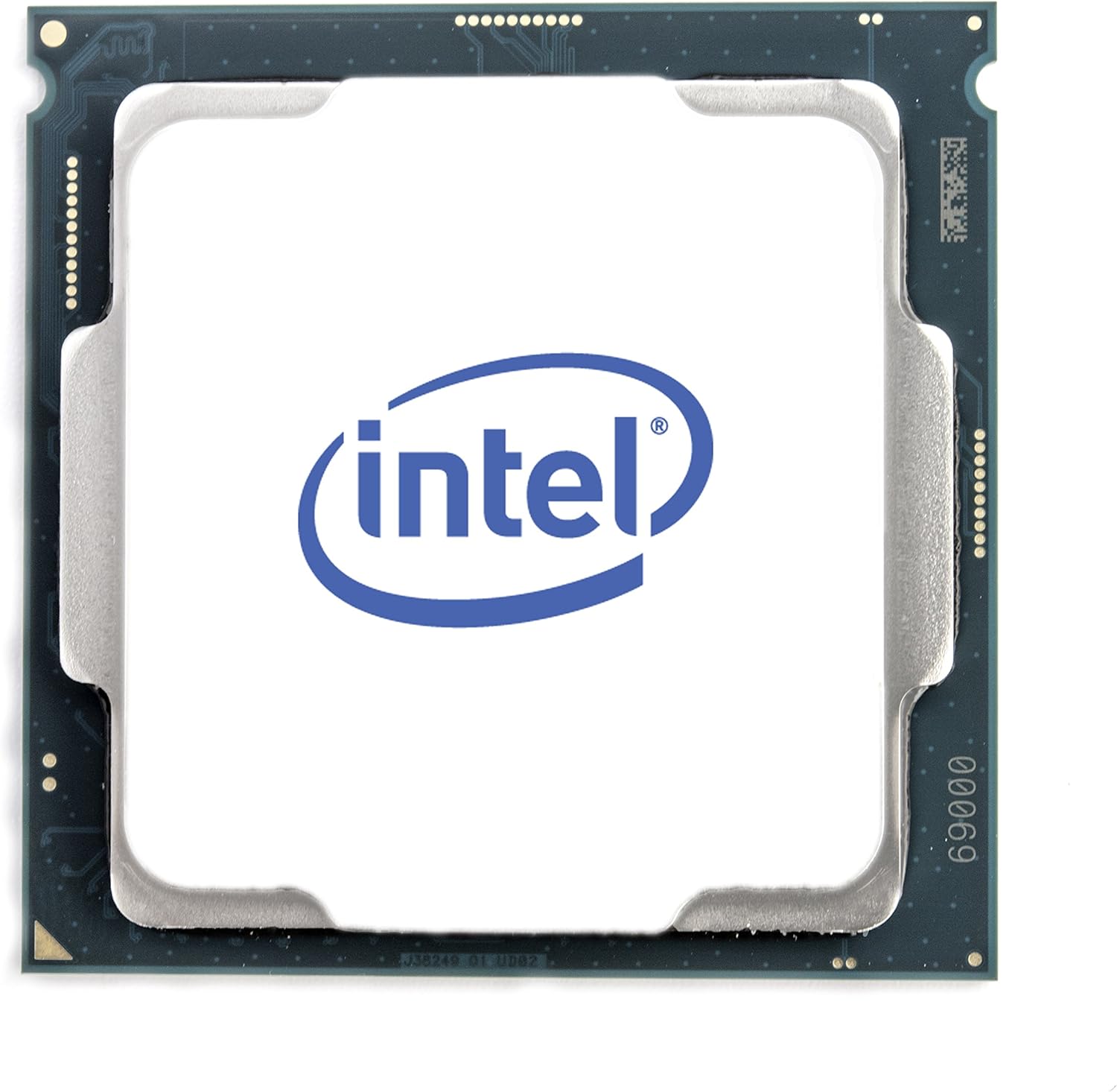
Figure 1 : Haut view of the Intel Core i7-8700 processor. This image displays the processor's integrated heat spreader with the Intel logo, indicating the orientation for installation.

Figure 2 : Bas view of the Intel Core i7-8700 processor. This image illustrates the contact pads on the underside of the processor, which connect to the motherboard's LGA 1151 socket.
2. Informations d'exploitation
The Intel Core i7-8700 processor is designed for general computing tasks, including gaming, content creation, and everyday productivity. It features Intel UHD Graphics 630, allowing for basic display output without a dedicated graphics card, though a discrete GPU is recommended for demanding graphical applications.
2.1 Configuration requise
- Carte mère: Intel 300 Series Chipset with LGA 1151 socket.
- BÉLIER: DDR4 memory (specific speeds and capacities depend on motherboard support).
- Alimentation: eau adéquatetage to support the CPU and other system components.
- Système opérateur: Compatible with Windows 10 (64-bit), Linux distributions, etc.
2.2 Fonctionnalités de performances
- Technologie Intel Hyper-Threading : Allows each physical core to run two threads simultaneously, improving multitasking performance.
- Technologie Intel Turbo Boost : Dynamically increases the processor's frequency up to 4.60 GHz when needed, optimizing performance for demanding workloads.
- Mémoire Intel Optane prise en charge : Enhances system responsiveness by accelerating frequently accessed data.
3. Entretien
While processors generally require minimal maintenance, ensuring proper cooling and a clean environment can extend their lifespan and maintain optimal performance.
- Pâte thermique : Avec le temps, la pâte thermique peut sécher. Si vous constatez une augmentation de la température du processeur, pensez à appliquer de la pâte thermique neuve.
- CPU Cooler Cleaning: Regularly clean dust from your CPU cooler's heatsink and fan. Accumulated dust can impede airflow and lead to overheating. Use compressed air for this purpose.
- Flux d'air du boîtier : Assurez-vous que le boîtier de votre ordinateur bénéficie d'une ventilation suffisante pour dissiper efficacement la chaleur. Veillez à ce que les grilles d'aération (entrée et sortie d'air) ne soient pas obstruées.
- Mises à jour du BIOS/UEFI : Keep your motherboard's BIOS/UEFI firmware updated. These updates often include performance improvements, bug fixes, and enhanced compatibility.
4. Dépannage
Cette section aborde les problèmes courants que vous pourriez rencontrer avec votre processeur.
| Problème | Cause possible | Solution |
|---|---|---|
| Le système ne démarre pas / Aucun affichage. | Improper CPU installation, bent pins (unlikely for LGA), incompatible motherboard, insufficient power. |
|
| Températures élevées du processeur. | Insufficient thermal paste, improperly seated CPU cooler, poor case airflow, faulty cooler fan. |
|
| Instabilité du système / Plantages. | Overheating, unstable overclock (if applied), faulty RAM, driver issues. |
|
5. Spécifications
Detailed technical specifications for the Intel Core i7-8700 processor (SR3QS).
- Cores / Threads: 6 cœurs / 12 threads
- Fréquence d'horloge de base : 3.20 GHz
- Fréquence turbo maximale : Jusqu'à 4.60 GHz
- Cache: 12 Mo de cache intelligent Intel
- Vitesse du bus : 8 GT/s DMI3
- TDP: 65 W
- Douille: LGA 1151
- Lithographie: 14 nm
- Graphiques intégrés : Carte graphique Intel UHD 630
- Jeu d'instructions: 64 bits
- Extensions du jeu d'instructions : Intel SSE4.1, Intel SSE4.2, Intel AVX2
- Technologies prises en charge : Intel Hyper-Threading Technology, Intel Turbo Boost Technology, Intel Optane Memory Supported
- Dimensions du produit : 4.7 x 4.2 x 4.7 pouces
- Poids de l'article : 0.811 onces
6. Garantie et assistance
This Intel Core i7-8700 processor is a renewed product. Renewed products typically come with a limited warranty provided by the seller or refurbisher, not directly by the original manufacturer (Intel) for the renewed status. Please refer to the specific warranty information provided at the point of purchase or by the seller, "Maestro Tech Reconditioned".
For technical support related to installation or troubleshooting, it is recommended to consult your motherboard's manual, the seller's support channels, or Intel's official support resources for general processor information.
Vendeur: Maestro Tech Reconditioned
Typical Return Policy: 90-day refund/replacement (as per product listing information).
Pour obtenir de l'aide supplémentaire, vous pouvez consulter le Boutique Amazon Renewed ou contactez directement le vendeur.