1. Introduction
The midiplus Origin 37 is a versatile USB MIDI Keyboard Controller designed for musicians and producers. It features 37 full-size sensitive keys, 8 real-time controller knobs, 9 real-time controller sliders, and essential performance controls like pitch bend and modulation wheels. This manual provides detailed instructions for setting up, operating, and maintaining your Origin 37 controller to ensure optimal performance and longevity.
2. Consignes de sécurité
- N’exposez pas l’appareil à la pluie, à l’humidité ou à des températures extrêmes.
- Évitez de placer l'appareil à proximité de sources de chaleur telles que des radiateurs, des bouches de chauffage, des poêles ou d'autres appareils (y compris amp(échangeurs thermiques) qui produisent de la chaleur.
- Utilisez uniquement les accessoires spécifiés par le fabricant.
- Nettoyer uniquement avec un chiffon sec.
- Ne pas obstruer les ouvertures de ventilation. Procéder à l'installation conformément aux instructions du fabricant.
- Protégez le cordon d’alimentation pour éviter qu’il ne soit piétiné ou pincé, en particulier au niveau des fiches, des prises de courant et du point de sortie de l’appareil.
- Débranchez cet appareil en cas d’orage ou lorsqu’il n’est pas utilisé pendant de longues périodes.
3. Contenu du colis
Veuillez vérifier que tous les articles énumérés ci-dessous sont inclus dans votre colis :
- midiplus Origin 37 USB MIDI Keyboard Controller
- Câble USB
- Manuel du propriétaire (ce document)
4. Produit terminéview
Familiarize yourself with the various components and controls of your Origin 37 controller.
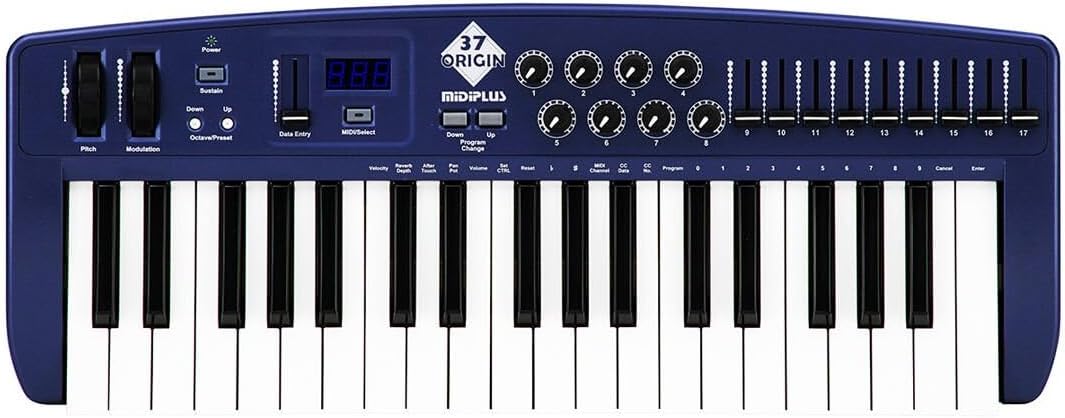
Figure 4.1 : Vue de dessus view of the midiplus Origin 37, showing the 37 keys, pitch and modulation wheels, control knobs, sliders, and display.
4.1 Commandes du panneau avant
- 37 Full-Size Sensitive Keys: Standard piano-style keys for playing notes.
- Molette de variation de ton: Permet la modulation de hauteur des notes en temps réel.
- Roue de modulation : Provides real-time control over various assignable parameters, typically vibrato or other effects.
- Bouton d'alimentation : Allume ou éteint l'appareil.
- Bouton de maintien : Toggles sustain on/off, mimicking a sustain pedal.
- Boutons d'octave supérieure/inférieure : Shifts the keyboard's octave range up or down.
- Data Entry Slider: Used for adjusting parameter values shown on the display.
- MIDI/Select Button: Used to enter MIDI configuration mode or select options.
- Boutons de programmation Haut/Bas : Navigates through different program or preset numbers.
- 8 Real-Time Controller Knobs (1-8): Assignable rotary encoders for controlling various MIDI parameters.
- 9 Real-Time Controller Sliders (9-17): Assignable faders for controlling various MIDI parameters.
- Affichage LED: Shows current parameter values, program numbers, and other status information.

Figure 4.2: Detail of the left-side controls, including Pitch Bend, Modulation, Power, Sustain, Octave Up/Down, Data Entry slider, and LED display.
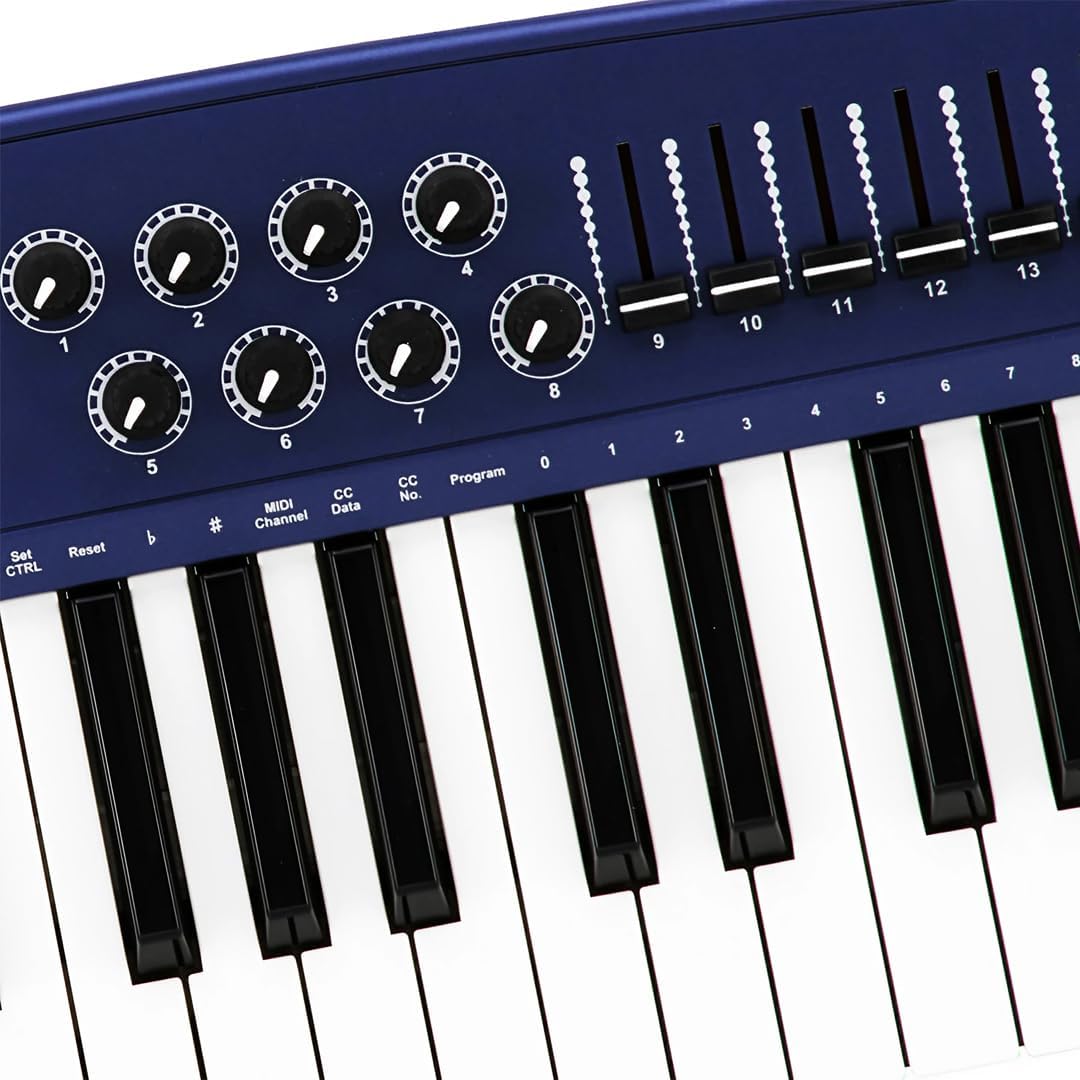
Figure 4.3: Detail of the right-side controls, showing the 8 rotary knobs and 9 faders, along with key labels for MIDI configuration.
4.2 Connexions du panneau arrière
- Sustain Switch Input: 1/4-inch jack for connecting an external sustain pedal (not included).
- KEYBOARD MIDI OUT (5-pin DIN): Standard MIDI output for connecting to other MIDI devices.
- Port USB : For connecting to a computer (PC/Mac) for MIDI communication and power.
- Interrupteur: Interrupteur d'alimentation principal de l'unité.

Figure 4.4: Rear panel showing the Sustain Switch input, KEYBOARD MIDI OUT, USB port, and Power switch.
5. Installation
5.1 Connexion à un ordinateur (USB)
- Assurez-vous que votre ordinateur est sous tension.
- Connect one end of the supplied USB cable to the USB port on the rear panel of the Origin 37.
- Connectez l’autre extrémité du câble USB à un port USB disponible sur votre ordinateur.
- The Origin 37 is USB class-compliant and does not require special drivers for most operating systems (PC/Mac). It will be powered via the USB connection.
- Turn on the Origin 37 using the Power button on the front panel.
- Your computer should automatically recognize the device. You can then select it as a MIDI input device in your Digital Audio Workstation (DAW) or music software (e.g., Ableton Live).
5.2 Connecting to External MIDI Devices (MIDI OUT)
- Ensure both the Origin 37 and the external MIDI device are powered off.
- Connect a standard 5-pin MIDI cable from the "KEYBOARD MIDI OUT" port on the Origin 37 to the MIDI IN port of your external MIDI device (e.g., synthesizer, sound module).
- Power on the Origin 37, then power on your external MIDI device.
- Configure your external MIDI device to receive MIDI data on the appropriate MIDI channel.
5.3 Connexion d'une pédale de sustain
- Connect a standard 1/4-inch TS (mono) sustain pedal (not included) to the "Sustain Switch" input on the rear panel.
- The pedal will function as a sustain control for your MIDI notes.
6. Mode d'emploi
6.1 Fonctionnement de base
- Jouer des touches : Simply press the keys to send MIDI note-on/note-off messages to your connected software or hardware. The keys are velocity-sensitive, meaning the harder you press, the higher the velocity value sent.
- Molette de variation de ton: Move the wheel up or down to bend the pitch of currently held notes. It automatically returns to the center position.
- Roue de modulation : Move the wheel to apply modulation effects. This wheel typically stays in the position you leave it. The specific effect controlled depends on your software or hardware instrument's settings.
- Bouton de maintien : Press to toggle sustain on or off. When active, notes will continue to sound after the key is released, similar to a piano's sustain pedal.
- Octave Up/Down: Use these buttons to transpose the entire keyboard up or down in octave increments. The LED display will indicate the current octave shift.
- Program Up/Down: These buttons are used to send MIDI Program Change messages, allowing you to switch between different sounds or presets on your connected MIDI device or software.
6.2 Assigning Knobs and Sliders
The 8 knobs and 9 sliders are assignable MIDI controllers. They send MIDI Control Change (CC) messages. The specific CC number each knob/slider sends can be configured. Refer to your software's or hardware's manual for how to map these CC messages to parameters.
To assign a knob or slider:
- Appuyez sur le MIDI/Select button to enter configuration mode.
- Utilisez le Saisie de données slider or Octave Up/Down buttons to navigate through parameters on the LED display.
- Select the desired knob or slider to assign.
- Adjust the value (e.g., MIDI CC number) using the Saisie de données curseur.
- Presse MIDI/Select again to exit configuration mode and save changes.
Note: Specific assignment procedures may vary. Consult the detailed MIDI implementation chart (if available) or your DAW's manual for advanced mapping.
6.3 Data Entry and Display
The LED display provides visual feedback for various settings and parameters. The Saisie de données slider is primarily used to adjust numerical values shown on this display, such as MIDI channel, CC numbers, or program numbers during configuration.
7. Entretien
- Nettoyage: Utilisez un chiffon doux et sec pour nettoyer la surface de l'appareil. N'utilisez pas de nettoyants abrasifs, de cires ni de solvants.
- Stockage: Lorsqu'il n'est pas utilisé pendant une période prolongée, rangez le contrôleur dans un endroit frais et sec, à l'abri de la lumière directe du soleil et des températures extrêmes.
- Manutention: Évitez de laisser tomber l'appareil ou de le soumettre à des chocs violents.
- Pouvoir: Always disconnect the USB cable when the unit is not in use or during electrical storms.
8. Dépannage
| Problème | Cause possible | Solution |
|---|---|---|
| Pas d'alimentation / L'appareil ne s'allume pas. | Câble USB non connecté ou défectueux. | Ensure USB cable is securely connected to both the controller and a powered USB port. Try a different USB port or cable. |
| No sound from software/hardware. | MIDI input not selected in software; incorrect MIDI channel; software instrument not loaded. | Verify the Origin 37 is selected as a MIDI input device in your DAW. Check that the MIDI channel on the controller matches the receiving channel of your software/hardware. Ensure a sound-generating instrument is loaded and active. |
| Knobs/Sliders do not control parameters. | Not mapped in software; incorrect MIDI CC assignment. | Ensure the knobs/sliders are correctly mapped to parameters within your DAW or software instrument. Check the MIDI CC numbers being sent by the controller and ensure they match the expected input. |
| Keys are not responding or sending incorrect notes. | Connection issue; software conflict. | Reconnect the USB cable. Restart your computer and DAW. Check for any conflicting MIDI drivers or software. |
| LED display flickering or unstable. | Fluctuation de courant ; défaut interne. | Ensure a stable USB power source. Try connecting to a different USB port or a powered USB hub. If the issue persists, contact customer support. |
9. Spécifications
| Fonctionnalité | Détail |
|---|---|
| Clés | 37 full-size, velocity-sensitive keys |
| Contrôleurs | Pitch Bend Wheel, Modulation Wheel, 8 Assignable Knobs, 9 Assignable Sliders, Sustain Button, Octave Up/Down, Program Up/Down, Data Entry Slider |
| Afficher | Affichage LED |
| Relations | USB (Type B), 5-pin MIDI OUT, 1/4" Sustain Switch Input |
| Alimentation électrique | Alimentation par bus USB |
| Compatibilité | PC, Mac (USB Class Compliant) |
| Dimensions (L x l x H) | 27.56 x 10.24 x 4.13 pouces (70 x 26 x 10.5 cm) |
| Poids | 6.39 livres (2.9 kg) |
10. Garantie et assistance
10.1 Informations sur la garantie
Midiplus products are designed and manufactured to the highest quality standards. For specific warranty terms and conditions, please refer to the warranty card included with your product or visit the official Midiplus webConsultez le site. Conservez votre reçu d'achat comme preuve d'achat pour toute réclamation au titre de la garantie.
10.2 Assistance clientèle
If you encounter any issues or have questions not covered in this manual, please contact Midiplus customer support. You can typically find contact information on the official Midiplus websur le site ou auprès de votre détaillant.
Pour obtenir de l'aide supplémentaire, vous pouvez consulter le Midiplus Store on Amazon.


