1. Introduction
This manual provides essential information for the safe and efficient installation, operation, and maintenance of the EUCHNER NZ1HS-3131-M Safety Switch. Please read this manual thoroughly before using the device to ensure proper function and to prevent potential hazards.
2. Consignes de sécurité
Avertissement: This device is a safety component. Improper installation or use can lead to serious injury or death. Always adhere to local and national safety regulations, including machine safety directives.
- Assurez-vous que l’alimentation est débranchée avant l’installation ou l’entretien.
- Seul le personnel qualifié est habilité à installer, utiliser et entretenir cet appareil.
- Ne pas contourner ou tamper with the safety functions of the switch.
- Regularly inspect the switch for damage or wear.
3. Produit terminéview
The EUCHNER NZ1HS-3131-M is a safety switch designed for monitoring the position of movable guards on machinery. It features a lever arm with a roller, providing reliable actuation. Its robust construction ensures durability in industrial environments.
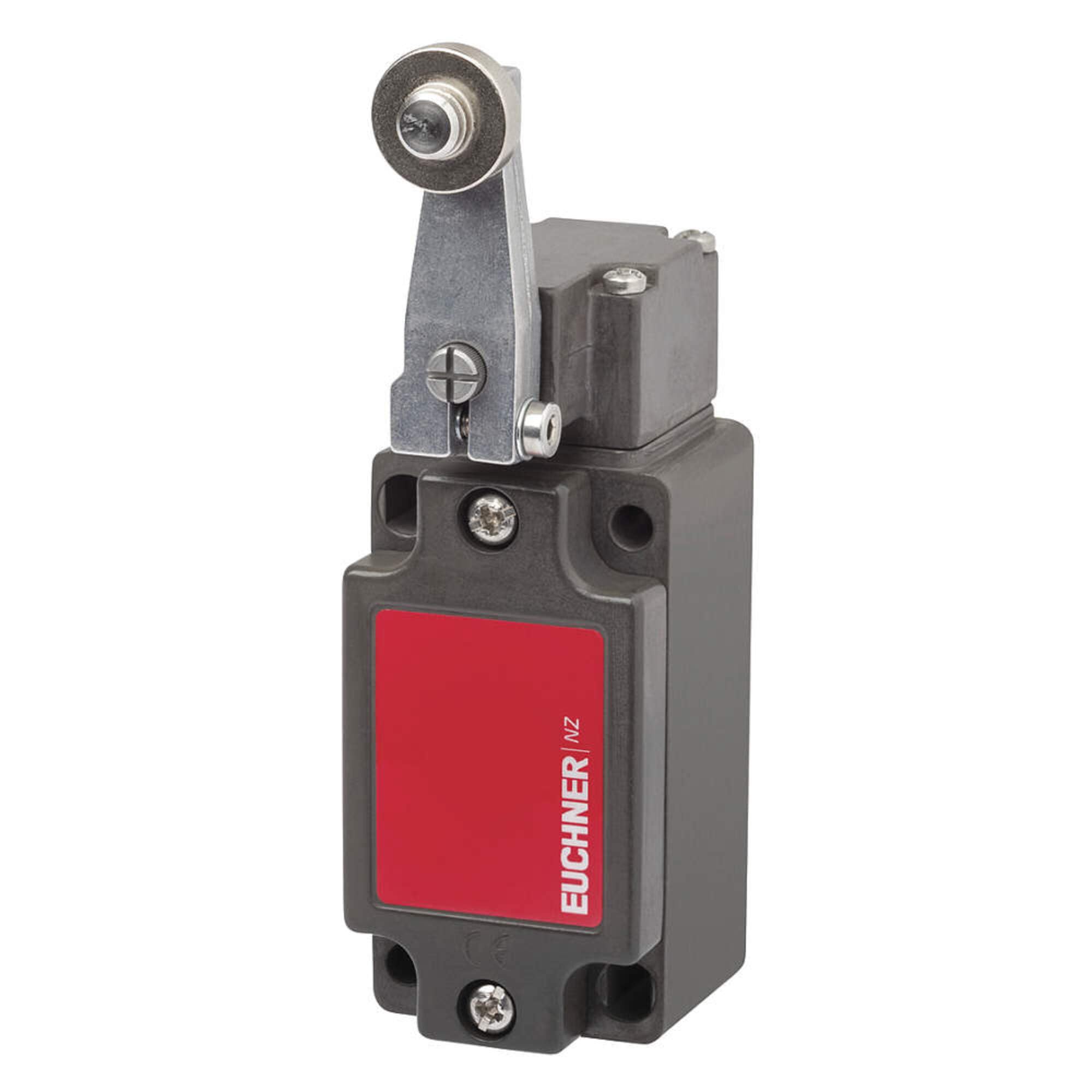
Figure 1: EUCHNER NZ1HS-3131-M Safety Switch. This image shows the safety switch with its distinctive lever arm and roller, which is used for actuation.
Composants clés :
- Logement: Protège les composants internes.
- Lever Arm with Roller: The actuating element that detects guard position.
- Port de connexion : For electrical wiring (M20 x 1.5).
4. Configuration et installation
Proper installation is critical for the safety switch's functionality. Follow these steps carefully:
- Montage: Securely mount the safety switch to a stable surface near the movable guard. Ensure the lever arm can be actuated freely by the guard.
- Câblage :
- Disconnect all power to the machine before wiring.
- Connect the electrical wiring to the M20 x 1.5 connection port.
- Use wires with a cross-section of 0.34 to 1.5 mm2.
- Ensure connections comply with the rated voltage of 230V AC / 24V DC and current rating of 4 Amps.
- Vérifiez la polarité correcte des connexions CC.
- Ajustement: Adjust the position of the switch and/or the guard so that the lever arm is actuated correctly when the guard is closed, and released when the guard is open. The switch should operate reliably throughout the guard's movement range.
- Essai: After installation, perform a functional test to ensure the safety switch operates as intended. Verify that the machine cannot start or stops immediately when the guard is opened.
5. Mode d'emploi
The NZ1HS-3131-M safety switch operates in an ON-OFF mode, designed to monitor the state of a machine guard. When the guard is closed, the lever arm is actuated, changing the state of the internal contacts (4PST, SPDT terminal). This signals to the control system that the guard is in a safe position, allowing machine operation.
When the guard is opened, the lever arm is released, causing the contacts to switch state. This action should immediately stop or prevent the start of hazardous machine functions, ensuring operator safety.
Séquence de fonctionnement normale :
- Guard Closed: Lever arm actuated, safety circuit closed (or open, depending on specific wiring and safety logic). Machine operation permitted.
- Guard Opened: Lever arm released, safety circuit opened (or closed). Machine operation interrupted or prevented.
6. Entretien
Regular maintenance ensures the longevity and reliable operation of the safety switch.
- Inspection visuelle : Periodically inspect the switch for any signs of physical damage, corrosion, or wear on the lever arm and roller.
- Nettoyage: Keep the switch free from dust, dirt, and debris. Use a soft, dry cloth for cleaning. Avoid abrasive cleaners or solvents.
- Vérification fonctionnelle : Regularly test the switch's operation by opening and closing the guard to confirm it correctly interrupts or prevents machine operation.
- Vérification de la connexion : Veillez à ce que toutes les connexions électriques restent bien fixées et exemptes de corrosion.
If any damage or malfunction is detected, replace the switch immediately. Do not attempt to repair the safety switch.
7. Dépannage
This section addresses common issues you might encounter with the NZ1HS-3131-M safety switch.
| Problème | Cause possible | Solution |
|---|---|---|
| Switch does not actuate when guard closes. | Incorrect alignment of switch or guard; damaged lever arm. | Adjust switch or guard position. Inspect and replace if lever arm is damaged. |
| Machine does not stop when guard opens. | Faulty wiring; damaged switch contacts; bypass of safety circuit. | Check wiring for proper connection and integrity. Test switch contacts. Ensure no unauthorized bypasses are present. Replace switch if faulty. |
| Fonctionnement intermittent. | Loose connections; excessive vibration; wear on mechanical parts. | Tighten all electrical connections. Secure switch mounting. Inspect for wear and replace if necessary. |
If troubleshooting steps do not resolve the issue, contact a qualified technician or EUCHNER support.
8. Spécifications
Technical specifications for the EUCHNER NZ1HS-3131-M Safety Switch:
| Fonctionnalité | Détail |
|---|---|
| Numéro de modèle | NZ1HS-3131-M |
| Mode de fonctionnement | ALLUMÉ ÉTEINT |
| Actuating Element | Lever Arm with Steel Roller |
| Isolation nominale Voltage | 250 V |
| Vol évaluétage | 230 V CA / 24 V CC |
| Évaluation actuelle | 4 Amps (Thermal Rated Current) |
| Courant de commutation | 1 mA à 24 V CC |
| Type de contact | 4PST |
| Terminal | SPDT |
| Connexion | M20 x 1.5 |
| Connection Cross-Section | 0.34 ... 1.5 mm2 |
| Évaluation de la protection internationale | IP54 |
| Dimensions du produit (L x l x H) | 0.31 x 0.31 x 0.28 pouces |
| Poids de l'article | 2 livres |
| Matériel | Steel (Contact Material) |
9. Garantie et assistance
Les informations relatives à la garantie du produit et au service client sont généralement fournies avec l'emballage du produit ou disponibles sur le site officiel du fabricant. website. Please refer to EUCHNER's official documentation or website for details on warranty terms, technical support, and service options.


