1. Introduction
The Marshall Acoustic Soloist AS50D is a 50-watt acoustic guitar amplifier designed to provide clear and expressive amplification for acoustic instruments and vocals. It features two independent channels, digital chorus, and reverb effects, making it suitable for various performance and practice environments. This manual provides essential information for the proper setup, operation, and maintenance of your AS50D amplifier.
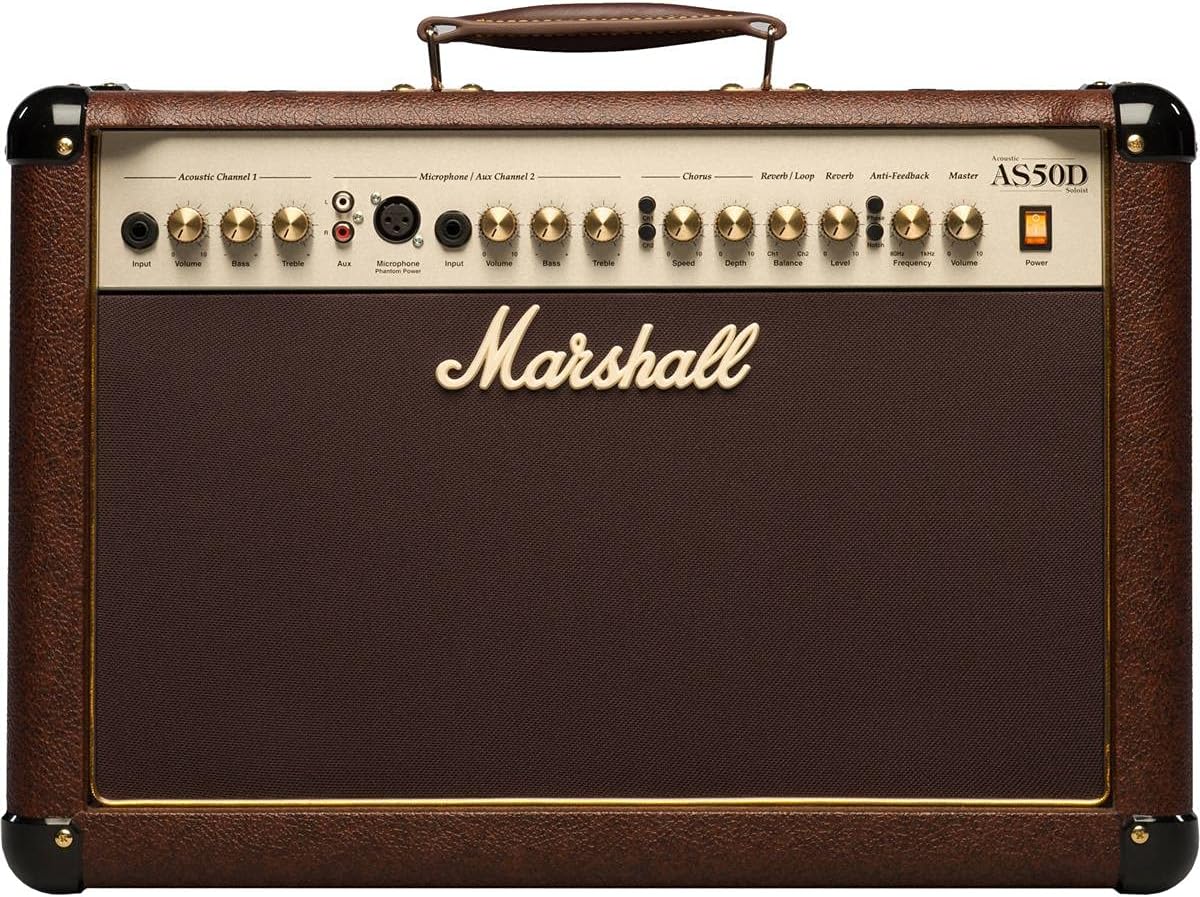
Illustration 1.1 : Avant view of the Marshall AS50D Acoustic Soloist Ampamplificateur, montreasing its control panel and speaker grille.
2. Installation
- Déballage: Retirez soigneusement le ampRetirez le produit de son emballage. Conservez tous les matériaux d'emballage pour un transport ou un stockage ultérieur.
- Placement: Placez le amplifier on a stable, flat surface. Ensure adequate ventilation around the unit to prevent overheating. Avoid placing it near heat sources or in direct sunlight.
- Connexion électrique : Assurez-vous que amplifier's power switch is in the 'OFF' position. Connect the supplied power cord to the amplifier's IEC inlet on the rear panel and then to a suitable grounded AC power outlet. The AS50D operates on 220-240V ~ 50Hz or 120V ~ 60Hz depending on the region.
- Connexions initiales :
- For acoustic guitars or other instruments, connect a standard 1/4" (6.35mm) instrument cable from your instrument to the 'Input' jack of 'Acoustic Channel 1'.
- For microphones, connect an XLR cable from your microphone to the 'Microphone Input' of 'Microphone / Aux Channel 2'.
- For external audio devices like MP3 players or drum machines, connect them to the 'Aux Input' RCA phono jacks on 'Microphone / Aux Channel 2'.
- Mise sous tension : Une fois toutes les connexions sécurisées, passez au commutateur. amplifier's power switch to the 'ON' position. The power indicator light will illuminate.
3. Mode d'emploi
The AS50D features a comprehensive control panel designed for intuitive operation. Familiarize yourself with each section:
3.1. Acoustic Channel 1
- Saisir: 1/4" (6.35mm) jack for connecting acoustic instruments.
- Volume: Controls the overall output level of Channel 1.
- Basse: Adjusts the low-frequency response of Channel 1.
- Tripler: Adjusts the high-frequency response of Channel 1.
3.2. Microphone / Aux Channel 2
- Entrée microphone : XLR input for connecting condenser or dynamic microphones.
- Puissance fantôme: Switch to activate +48V phantom power for condenser microphones. Ensure microphone is connected before activating.
- Input (Aux): 1/4" (6.35mm) jack for connecting instruments.
- Volume: Controls the overall output level of Channel 2.
- Basse: Adjusts the low-frequency response of Channel 2.
- Tripler: Adjusts the high-frequency response of Channel 2.
- Aux : Stereo RCA phono inputs for connecting external audio devices (e.g., MP3 players).
3.3. Section Effets
- Chorus Speed: Adjusts the rate of the digital chorus effect.
- Chorus Depth: Adjusts the intensity of the digital chorus effect.
- Reverb / Loop Balance: Blends the dry signal with the effects loop return signal.
- Reverb / Loop Level: Controls the overall level of the effects loop and reverb.
- Niveau de réverbération : Controls the intensity of the digital reverb effect.
3.4. Section principale
- Anti-Feedback Notch: Activates the notch filter to reduce feedback.
- Anti-Feedback Frequency: Adjusts the frequency range targeted by the notch filter. Rotate to find and eliminate problematic feedback frequencies.
- Volume principal : Contrôle le volume de sortie général du amplifier.
- Pouvoir: Interrupteur principal d'alimentation pour le amplifier.
3.5. Connexions du panneau arrière

Image 3.5.1 : Arrière view of the Marshall AS50D Acoustic Soloist Amplifier, showing the power input, footswitch, DI out, and effects loop connections.
- Pédale de commande : Entrée pour une pédale de commande optionnelle permettant de contrôler les effets.
- D.I. Out: XLR output for direct connection to a mixing console or recording device.
- Effects Loop Send: Output to send signal to external effects processors.
- Effects Loop Return: Input to receive signal from external effects processors.
4. Entretien
- Nettoyage: Déconnecter le amplifier from power before cleaning. Use a soft, dry cloth to wipe down the exterior. Do not use abrasive cleaners or solvents.
- Stockage: Stocker le amplifier in a dry, temperate environment, away from extreme temperatures and humidity. If possible, use a protective cover to prevent dust accumulation.
- Transport: Lors du déplacement du amplifier, ensure it is powered off and disconnected. Use the integrated handle for carrying.
- Entretien: Confiez toute réparation à un personnel qualifié. N'essayez pas d'ouvrir le ampchâssis lificateur.
5. Dépannage
- Pas d'alimentation :
- Vérifiez que le cordon d'alimentation est bien connecté aux deux ampamplificateur et prise murale.
- Vérifiez que la prise murale est fonctionnelle.
- Assurez-vous que amplifier's power switch is in the 'ON' position.
- Pas de son :
- Check all instrument and microphone cables for secure connections and proper functionality.
- Ensure the 'Volume' controls for the active channel and the 'Master Volume' are turned up.
- Verify that your instrument or microphone is working correctly.
- Distortion at High Volumes:
- Reduce the 'Volume' control for the active channel or the 'Master Volume'.
- Ensure your input signal is not too strong. Adjust the output level of your instrument if possible.
- Check the quality of your instrument cables; faulty cables can introduce noise and distortion.
- Feedback (Howling Sound):
- Engage the 'Anti-Feedback Notch' switch.
- Slowly rotate the 'Anti-Feedback Frequency' knob to find and eliminate the problematic frequency.
- Reduce the 'Volume' of the affected channel or the 'Master Volume'.
- Move further away from the amplifier or change your position relative to the speakers.
6. Spécifications
| Fonctionnalité | Spécification |
|---|---|
| Numéro de modèle | M-AS50D-U |
| Puissance de sortietage | 50 watts |
| Nombre de haut-parleurs | 2 |
| Taille du haut-parleur | 8-inch woofers (x2) |
| Chaînes | 2 (Acoustic, Microphone/Aux) |
| Effets | Digital Chorus, Digital Reverb |
| Entrées | 1/4" Jack, XLR, Stereo RCA |
| Sorties | D.I. Out (XLR), Effects Loop Send/Return |
| Phantom Power | +48V (commutable) |
| Anti-Feedback | Notch Filter with Frequency Control |
| Poids de l'article | 35.3 livres (16 kg) |
| Dimensions du produit | 21.34 x 10.28 x 16.38 pouces (54.2 x 26.1 x 41.6 cm) |
| Type de matériau | Métal |
| Source d'énergie | Électrique avec fil |
7. Garantie et assistance
This Marshall amplifier is covered by a manufacturer's warranty. Please refer to the warranty card included with your product for specific terms and conditions, including coverage duration and limitations. For technical support, service, or warranty claims, please contact your authorized Marshall dealer or visit the official Marshall Amplification website pour obtenir les coordonnées dans votre région.
Conservez votre preuve d'achat pour la validation de la garantie.


