1. Introduction
This manual provides instructions for the safe and effective use of the Sealey MM19 Digital Multimeter. The MM19 is a general-purpose multimeter designed for measuring various electrical parameters, including AC and DC voltage, DC current, resistance, audible continuity, and diode/transistor verification. Please read this manual thoroughly before operation and retain it for future reference.
2. Consignes de sécurité
Always observe basic safety precautions when using electrical test equipment to reduce the risk of fire, electric shock, or personal injury. This device complies with IEC 1010 and CE CAT II safety standards.
- Ne pas dépasser les limites d'entrée maximales for any function. Refer to the specifications section for details.
- Ne jamais appliquer voltage to the meter when the rotary switch is set to Resistance (Ω), Diode, Continuity, or Current (A) functions.
- Soyez prudent lorsque vous travaillez avec des volumestages supérieur à 30 V CA RMS, 42 V crête ou 60 V CC. Ces voltagils présentent un risque d'électrocution.
- Ensure the test leads are in good condition, without cracked or broken insulation.
- Always connect the common (COM) test lead first and disconnect it last.
- Disconnect power to the circuit under test before measuring resistance or continuity.
- Remplacez la batterie immédiatement lorsque le témoin de batterie faible apparaît afin de garantir des mesures précises.
3. Produit terminéview
The Sealey MM19 Digital Multimeter features a clear LCD display, a central rotary switch for function selection, and input jacks for test leads.
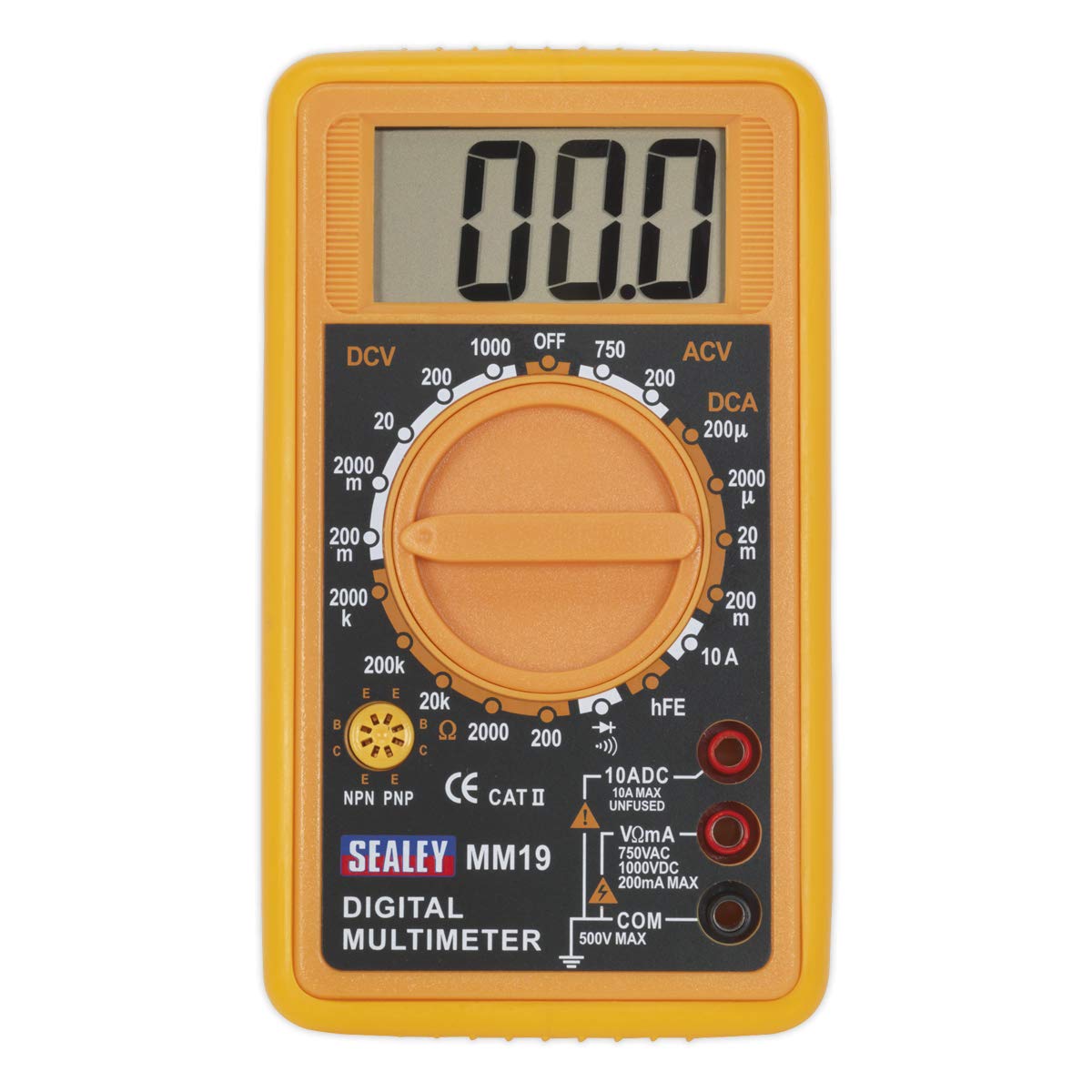
The Sealey MM19 Digital Multimeter, shown with its yellow casing, large LCD display, rotary function switch, and red and black test leads connected to the input jacks.
Composants:
- Écran LCD : Large (46 x 25mm) digital display for reading measurements.
- Commutateur rotatif : Permet de sélectionner la fonction et la plage de mesure souhaitées.
- Prise d'entrée VΩmA : Pour voltage, resistance, and current measurements up to 200mA.
- 10ADC Input Jack: For high current measurements up to 10A DC (unfused).
- Prise d'entrée COM : Entrée commune (négative) pour toutes les mesures.
- Connecteur hFE : Pour les tests de transistors (NPN/PNP).
- Fils d'essai: Fils rouge (positif) et noir (négatif) pour le raccordement aux circuits.
4. Installation
4.1. Installation de la batterie
The Sealey MM19 Multimeter requires a 9V battery for operation. If the display does not illuminate or shows a low battery indicator, the battery needs to be installed or replaced.
- Assurez-vous que le multimètre est éteint.
- Repérez le couvercle du compartiment à piles à l'arrière de l'appareil.
- Retirez la ou les vis fixant le couvercle et soulevez-le délicatement.
- Connectez une nouvelle pile 9V aux clips de la pile, en respectant la polarité.
- Placez la pile dans le compartiment et remettez le couvercle en place en le fixant avec la ou les vis.
4.2. Connexion des cordons de test
The multimeter is supplied with a pair of test leads (red and black).
- Insérer le cordon de test noir dans le COM Prise d'entrée (commune).
- Pour la plupart des mesures (voltage, resistance, low current), insert the plomb de test rouge dans le VΩmA prise d'entrée.
- For high DC current measurements (up to 10A), insert the plomb de test rouge dans le 10ADC prise d'entrée.
5. Mode d'emploi
To operate the multimeter, select the desired function and range using the rotary switch.
5.1. Mesurer le volume CCtage (DCV)
- Insert the red lead into the VΩmA jack and the black lead into the COM jack.
- Set the rotary switch to the desired DCV range (e.g., 200m, 2000m, 20, 200, 1000). Start with the highest range if the voltage est inconnu.
- Connectez les cordons de test aux bornes du composant ou du circuit à mesurer.
- Lire le voltage valeur sur l'écran LCD.
5.2. Mesure du Vol ACtage (ACV)
- Insert the red lead into the VΩmA jack and the black lead into the COM jack.
- Set the rotary switch to the desired ACV range (e.g., 200, 750). Start with the highest range if the voltage est inconnu.
- Connectez les cordons de test aux bornes du composant ou du circuit à mesurer.
- Lire le voltage valeur sur l'écran LCD.
5.3. Mesure du courant continu (DCA)
- Pour des courants jusqu'à 200 mA : Insert the red lead into the VΩmA jack and the black lead into the COM jack.
- Pour des courants jusqu'à 10 A : Insert the red lead into the 10ADC jack and the black lead into the COM jack.
- Set the rotary switch to the desired DCA range (e.g., 200μ, 2000μ, 20m, 200m, 10A). Start with the highest range if the current is unknown.
- Coupez l’alimentation du circuit. Open the circuit where the current is to be measured.
- Branchez le multimètre en série avec le circuit.
- Mettez le circuit sous tension et lisez la valeur du courant sur l'écran LCD.
5.4. Mesure de la résistance (Ω)
- Insert the red lead into the VΩmA jack and the black lead into the COM jack.
- Set the rotary switch to the desired Resistance (Ω) range (e.g., 200, 2000, 20k, 200k, 2000k).
- Assurez-vous que le circuit testé est hors tension.
- Connectez les cordons de test aux bornes du composant à mesurer.
- Lisez la valeur de résistance sur l'écran LCD.
5.5. Test de continuité sonore
- Insert the red lead into the VΩmA jack and the black lead into the COM jack.
- Set the rotary switch to the continuity symbol (speaker icon).
- Assurez-vous que le circuit testé est hors tension.
- Connectez les cordons de test aux bornes du composant ou du fil.
- If continuity exists (low resistance), the meter will emit an audible tone. The display will show the resistance value.
5.6. Diode/Transistor Verification Mode (hFE)
- Insert the red lead into the VΩmA jack and the black lead into the COM jack for diode testing.
- Réglez le commutateur rotatif sur le symbole de la diode.
- Connectez le fil rouge à l'anode et le fil noir à la cathode de la diode. L'afficheur indiquera la tension directe.tage chute. Inversez les fils ; l’afficheur doit indiquer « OL » (boucle ouverte) pour une diode en bon état.
- For transistor hFE measurement, insert the transistor leads (Emitter, Base, Collector) into the appropriate sockets (E, B, C) in the hFE test socket, ensuring correct NPN or PNP type selection.
- Read the hFE value on the LCD display.
6. Entretien
6.1. Nettoyage
Essuyez le compteur casing avec publicitéamp Nettoyez l'appareil avec un chiffon et un détergent doux. N'utilisez ni abrasifs ni solvants. Assurez-vous qu'il soit parfaitement sec avant utilisation.
6.2. Remplacement de la batterie
Refer to Section 4.1 for battery installation instructions. Replace the 9V battery when the low battery indicator appears on the display to maintain measurement accuracy.
7. Dépannage
- Pas d'affichage : Check battery installation and ensure the battery has sufficient charge.
- « OL » ou « 1 » affichés : This usually indicates an over-range condition or an open circuit. Select a higher range or check connections.
- Lectures incorrectes : Ensure the correct function and range are selected. Check test lead connections and battery condition.
- No Continuity Tone: Verify the circuit is de-energized and the leads are making good contact.
8. Spécifications
| Paramètre | Valeur |
|---|---|
| Marque | Sealey |
| Numéro de modèle | MM19 |
| Source d'énergie | Alimenté par batterie (9 V) |
| Afficher | Digital LCD (46 x 25mm) |
| Vol CCtage (DCV) | 200 mV, 2000 20 mV, 200 V, 1000 V, XNUMX V |
| Vol ACtage (ACV) | 200 V, 750 V |
| Courant continu (DCA) | 200µA, 2000µA, 20mA, 200mA, 10A |
| Résistance (Ω) | 200Ω, 2000Ω, 20kΩ, 200kΩ, 2000kΩ |
| Continuité | Audible tone below approx. 30Ω |
| Test de diode | Vol avanttage drop display |
| Test de transistor | hFE (NPN/PNP) |
| Cote de sécurité | CE CAT II, IEC 1010 |
| Dimensions (L x l x H) | 1.93 x 4.21 x 6.06 pouces |
| Poids de l'article | 9.5 onces (0.27 kilogrammes) |
9. Garantie et assistance
For warranty information or technical support, please refer to the documentation provided with your purchase or contact Sealey customer service directly. Keep your proof of purchase for any warranty claims.


