
1. Introduction
Welcome to the Dyness 12V 100Ah LiFePO4 Deep Cycle Battery user manual. This document provides essential information for the safe and efficient use of your battery. It is designed for various applications including RVs, marine systems, off-grid solar installations, and backup power. Please read this manual thoroughly before installation and operation.
2. Consignes de sécurité
AVERTISSEMENT : Le non-respect de ces consignes de sécurité peut entraîner des blessures graves, des dommages matériels ou la mort.
- Always wear appropriate personal protective equipment (PPE), including eye protection and insulated gloves, when handling batteries.
- Do not short-circuit the battery terminals. This can cause severe arcing, fire, or explosion.
- Tenez la batterie éloignée des sources de chaleur, des flammes nues et des matériaux inflammables.
- Do not disassemble, puncture, drop, or damage the battery. Internal components are hazardous.
- Assurez une ventilation adéquate pendant la charge et le fonctionnement afin d'éviter toute accumulation de chaleur.
- Use only compatible chargers specifically designed for LiFePO4 batteries (e.g., a 14.6V 20A lithium-ion charger). Using an incompatible charger can damage the battery or cause a fire.
- Avoid charging or discharging the battery outside the specified temperature ranges. The integrated BMS will provide protection, but external conditions should be monitored.
- En cas d'incendie, utilisez un extincteur de classe D. L'eau peut aggraver les incendies de lithium.
- Tenir hors de portée des enfants et des animaux domestiques.
- Do not connect the battery to a load or charger if it shows signs of damage, swelling, or leakage.
3. Produit terminéview
The Dyness 12V 100Ah LiFePO4 Deep Cycle Battery is a high-performance energy storage solution. It features Grade A+ lithium iron phosphate cells, offering a long cycle life and stable voltage output for reliable power.
Caractéristiques principales :
- Système de gestion de batterie avancé 100 A : An integrated Battery Management System provides comprehensive protection against overcharge, over-discharge, over-current, short-circuit, and extreme temperatures.
- Protection contre les basses températures : Charging automatically stops below 0°C (32°F), and discharging stops below -20°C (-4°F) to ensure safety and prolong battery life.
- Durée de vie prolongée du cycle : Designed for over 4,000 deep charge-discharge cycles, with minimal capacity loss, and up to 15,000 cycles under specific conditions.
- Faible taux d'autodécharge : Approximately 1-2% per month, significantly lower than lead-acid batteries, allowing for easier storage.
- Conception évolutive : Up to 16 battery modules can be connected (4 in series x 4 in parallel) to achieve a maximum system capacity of 51.2V and 400Ah (20,480 Wh).
- Léger: Weighs only 9.9 kg, approximately one-third the weight of comparable lead-acid batteries.

Image: Internal structure highlighting Grade A+ cells and the impressive 4000+ cycle life.
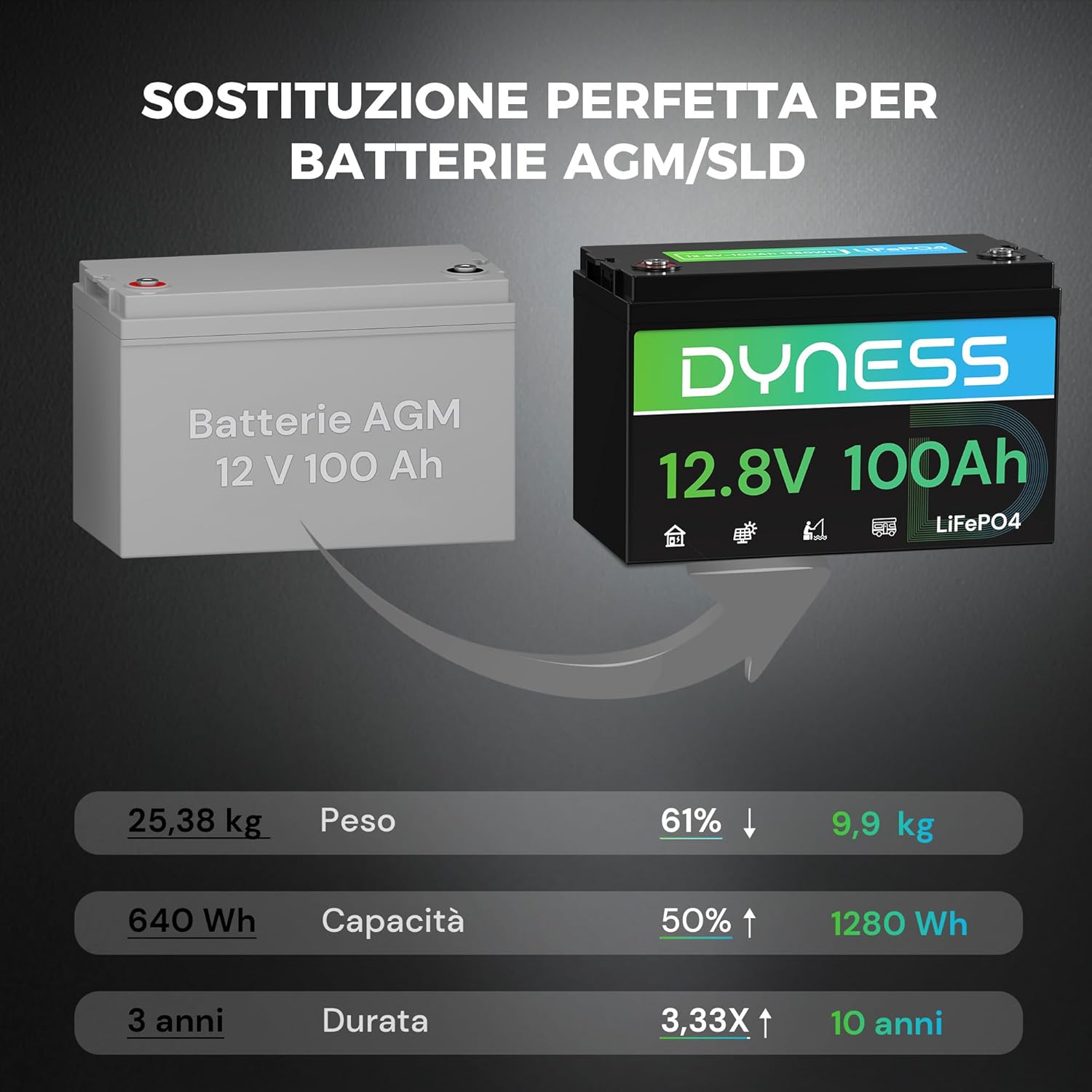
Image: Comparison of Dyness LiFePO4 battery with traditional AGM/SLA batteries, showing benefits in weight, capacity, and lifespan.
4. Installation
4.1 Déballage et inspection
Carefully remove the battery from its packaging. Inspect the battery for any signs of physical damage, such as cracks, dents, or swelling. If any damage is observed, do not proceed with installation and contact customer support immediately.
4.2 Frais initiaux
It is recommended to fully charge the battery before its first use to ensure optimal performance and calibration of the Battery Management System (BMS).
4.3 Connexion
Ensure all connections are secure and properly tightened to prevent resistance and potential hazards.
- Connectez la borne positive (+) de la batterie à la borne positive (+) de votre charge/chargeur.
- Connectez la borne négative (-) de la batterie à la borne négative (-) de votre charge/chargeur.
For Multiple Batteries:
- Connexion parallèle : To increase total capacity (Ampere-hours) while maintaining the nominal voltage (12.8V), connect positive terminals together and negative terminals together.
- Connexion en série : To increase total voltage, connect the positive terminal of one battery to the negative terminal of the next battery.
The Dyness 12V 100Ah battery supports connecting up to 16 modules (4 in series x 4 in parallel) for a maximum system of 51.2V 400Ah (20,480 Wh).
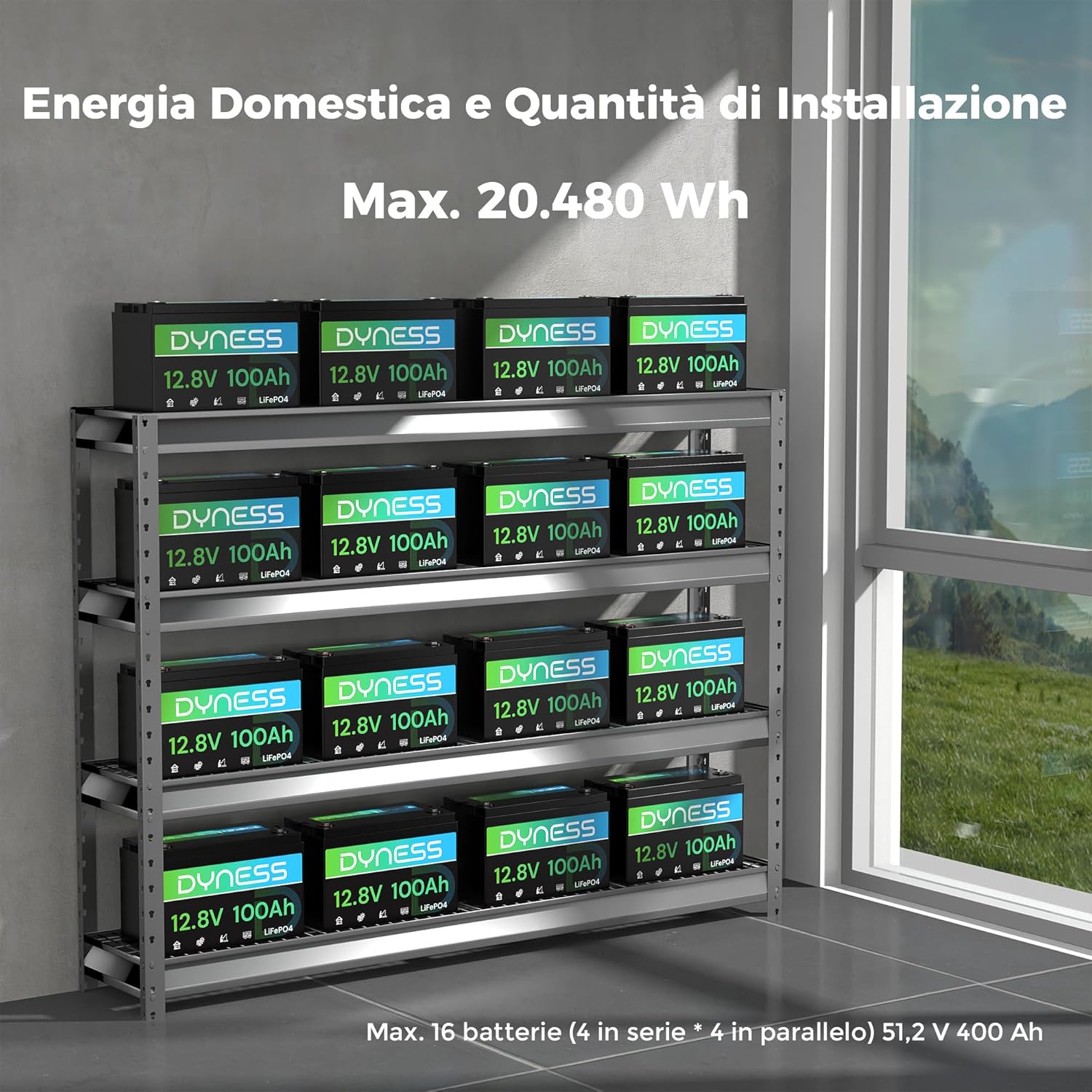
Image: Illustration of connecting multiple batteries for scalable energy storage, up to 16 modules.
4.4 Recommended Charger
Use a 14.6V 20A lithium-ion charger or connect to solar panels/generators with a rated power of ≥400W for optimal charging performance.
5. Mode d'emploi
5.1 Fonctionnement normal
The battery is designed for deep cycle applications, providing stable power output for extended periods. Monitor your system's voltage and current to ensure it operates within the battery's specifications.
5.2 Considérations relatives à la température
The integrated BMS actively protects the battery from extreme temperatures:
- Charging Cut-off: Charging will automatically cease if the battery temperature drops below 0°C (32°F).
- Discharging Cut-off: Discharging will automatically cease if the battery temperature drops below -20°C (-4°F).
- Charging Resumption: Charging resumes when the temperature rises above 5°C (41°F).
These features ensure the battery's longevity and safe operation in various climates.

Image: Explanation of the low temperature shutdown feature, detailing charging and discharging cut-off temperatures.
5.3 Applications
This battery is ideal for a wide range of applications:
- VR et Camples
- Marine and Boat Systems
- Off-grid Solar Systems
- Photovoltaic Energy Storage
- Systèmes d'alimentation de secours
Note: This battery is not suitable for automotive starting applications or vehicles requiring start-stop functionality.

Image: Dyness battery being used as an emergency power source for an RV.
6. Entretien
6.1 Inspection régulière
Periodically inspect the battery terminals for any signs of corrosion or loose connections. Ensure all connections are tight and clean.
6.2 Nettoyage
Gardez la batterie propre et sèche. Utilisez une publicitéamp cloth to wipe the exterior. Do not use solvents or abrasive cleaners, as these can damage the battery casing.
6.3 Stockage
If storing the battery for an extended period (more than one month), ensure it is charged to approximately 50-70% of its capacity. Store the battery in a cool, dry place, away from direct sunlight, moisture, and extreme temperatures. The low self-discharge rate of LiFePO4 batteries minimizes capacity loss during storage, but periodic checks are recommended.
7. Dépannage
Cette section propose des solutions aux problèmes courants que vous pourriez rencontrer. Si le problème persiste, veuillez contacter le service client.
7.1 La batterie ne se charge pas
- Vérifier les connexions : Ensure all charging cables are securely connected to both the battery and the charger.
- Vérifiez la compatibilité du chargeur : Confirm that your charger is specifically designed for LiFePO4 batteries and is functioning correctly.
- Contrôle de température : Ensure the ambient temperature is above 0°C (32°F). The BMS will prevent charging below this temperature.
7.2 Batterie ne se décharge pas / Aucune alimentation électrique
- Vérifier les connexions : Verify all load connections are secure and correct.
- Compatibilité de charge : Ensure the connected load is within the battery's specified current and power limits.
- Contrôle de température : Ensure the ambient temperature is above -20°C (-4°F). The BMS will prevent discharging below this temperature.
- Protection du système de gestion technique du bâtiment (GTB) : The BMS may have activated a protection mode (e.g., over-discharge, short-circuit, over-current). Disconnect the load, wait a few minutes, and try reconnecting. If the issue persists, contact support.
7.3 Unusual Odor or Swelling
Immediately disconnect the battery from all loads and chargers. Do not attempt to use or charge the battery. Contact Dyness customer support without delay.
8. Spécifications

Image: Detailed dimensions of the Dyness 12.8V 100Ah LiFePO4 battery.
| Spécification | Valeur |
|---|---|
| Marque | Dyness |
| Modèle | 12 V 100 Ah LiFePO4 |
| Vol nominaltage | 12.8 volts |
| Capacité | 100 Ampavant-heures (Ah) |
| Chimie des batteries | Phosphate de fer et de lithium (LiFePO4) |
| BMS intégré | 100A |
| Cycle de vie | Up to 15,000 cycles (4,000 cycles at 100% DoD) |
| Low Temperature Charge Cut-off | 0°C (32°F) |
| Low Temperature Discharge Cut-off | -20°C (-4°F) |
| Dimensions (L x l x H) | 33 x 17.2 x 21.4 cm (13 x 6.77 x 8.43 pouces) |
| Poids | 9.9 kg |
| Max. Series Connection | 4 piles |
| Max. Parallel Connection | 4 batteries (up to 16 total modules in 4S4P) |
| Certifications | CE/UN38.3 |
9. Garantie et assistance
9.1 Garantie
The Dyness 12V 100Ah LiFePO4 Deep Cycle Battery comes with a Garantie de 5 ans À compter de la date d'achat, cette garantie couvre les défauts de matériaux et de fabrication dans des conditions normales d'utilisation et d'entretien. Veuillez conserver votre preuve d'achat pour toute réclamation au titre de la garantie.
9.2 Assistance clientèle
For technical assistance, warranty claims, or any questions regarding your Dyness battery, please contact Dyness customer support. Dyness offers 24/7 customer assistance for immediate support. Refer to the official Dyness webConsultez le site ou vos documents d'achat pour obtenir les coordonnées les plus récentes.