
hosabely SK500
Hosabely SK500 Podcast Equipment Bundle Audio Interface User Manual
Modèle : SK500
Introduction
This manual provides detailed instructions for setting up, operating, and maintaining your Hosabely SK500 Podcast Equipment Bundle. Please read this manual thoroughly before using the product to ensure proper function and longevity.

Image: The Hosabely SK500 Podcast Equipment Bundle, featuring the audio interface, microphone, and stand.
Contenu du colis
Vérifiez que tous les éléments sont présents dans votre colis :
- 1x Audio Interface Mixer (SK500)
- 1x XLR to 3.5mm Microphone
- 1x support de trépied
- 1 casque filaire
- 1x Microphone Cable (XLR-3.5mm)
- Câble de chargement USB 1x
- 2x 3.5mm Audio Cables
- 1 manuel d'utilisation en anglais
Guide d'installation
Follow these steps to set up your Hosabely SK500 Podcast Equipment Bundle.
1. Mise sous tension et configuration initiale
- Mise sous tension : Long press the power button on the audio interface for approximately 5 seconds until the lights illuminate. The Bluetooth indicator will flash, indicating it's ready for pairing.
- Connect Headphones/Earphones: Plug your wired headphones or earphones into the designated "Earphone" port on the audio interface.
- Connecter le microphone : Plug the microphone cable into either "MIC 1" or "MIC 2" port on the audio interface.
- Appareil de recharge : Connect the USB charging cable from the "Charging Port" on the audio interface to a power bank or adapter for charging.
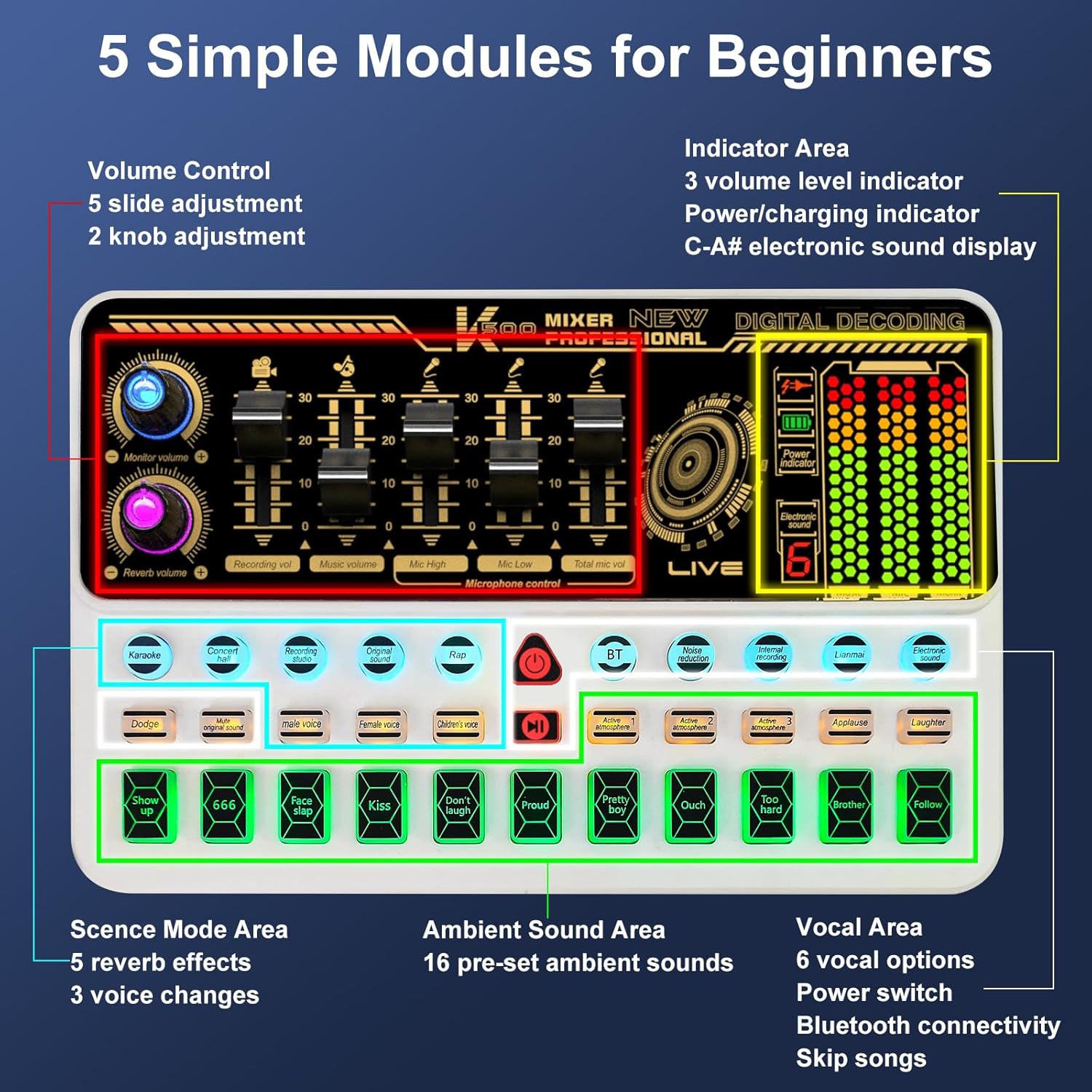
Image : Terminéview of the SK500 audio interface controls and indicators.
2. Connecting to a Phone or Tablet
- Jumelage Bluetooth: On your phone or tablet, enable Bluetooth and search for "SK500". Select it to pair.
- Connexion filaire (en option) : For phones without a 3.5mm jack, an OTG adapter (not included) is required. Connect a USB cable from the "OTG" port on the audio interface to your phone's USB port.
- Live Output: Connect one of the 3.5mm audio cables from the "Live" port on the audio interface to your phone's 3.5mm audio input (if available).
Video: Instructions on how to connect the SK500 sound board to your phone or pad.

Image: Diagram illustrating various connection methods for the SK500, including single phone, dual phone, phone+PC/laptop, and PC/laptop only setups.
3. Connecting to a PC or Laptop
- Connexion USB : Connect the USB charging cable from the "Charging Port" on the audio interface to your PC/laptop's USB port.
- Sélection de la sortie audio: On your PC/laptop, navigate to Sound Settings. Select "SK500 Studio" as the output device.
Video: Instructions on how to connect the SK500 sound board to your PC or laptop.
4. Connecting to a PS5
- Connexion USB : Connect the USB charging cable from the "Charging Port" on the audio interface to an available USB port on your PS5.
- Input/Output Device Selection: On your PS5, go to Settings > Sound.
- For Microphone Input Device, select "USB Headset (SK500)".
- For Audio Output Device, select "USB Headset (SK500)".
- Adjust Microphone Level: Adjust the microphone level in the PS5 settings to ensure optimal input volume.
Video: Instructions on how to connect the SK500 sound card to a PS5 console.
Mode d'emploi
The SK500 audio interface offers intuitive controls for various audio functions.
1. Contrôles du volume
The soundboard features 5 volume faders for precise adjustment:
- Volume du micro : Adjusts the input level of the connected microphone(s).
- Volume d'accompagnement : Controls the volume of background music or tracks.
- Volume d'enregistrement : Sets the overall recording level.
- Volume du moniteur : Adjusts the volume for your monitoring headphones.
- Reverb Volume: Controls the intensity of the reverb effects.

Image: Close-up of the SK500 audio mixer showing the 5 individual volume faders for precise control over microphone, music, and recording levels.
2. Voice Change Options
The SK500 offers 3 voice change options for creative alterations:
- Voix masculine
- Voix féminine
- Voix d'enfant

Image: The SK500 audio mixer highlighting the voice changer buttons for male, female, and child voices.
3. Reverb Modes and Sound Effects
Enhance your audio with various effects:
- 5 Reverb Modes: Includes Echo, Reverb, and Original Sound.
- 16 Preset Sound Effects: A variety of ambient sounds to enrich your recordings or performances.

Image: The SK500 audio mixer displaying the various sound effect buttons and reverb mode options.
4. Fonctionnalités avancées
- Réduction du bruit : Minimizes background noise for clearer audio.
- Amélioration de la voix : Improves vocal clarity and presence.
- Esquive : Automatically lowers background music when speech is detected.
- Supprimer les voix : Isolates instrumental tracks by removing lead vocals.
- Boucle de retour : Allows internal recording of audio output back into the system (useful for PC).
- Bluetooth 5.0: For seamless wireless accompaniment track input.
- Dual-Device Broadcasting: Supports simultaneous broadcasting to two devices.
- Surveillance en temps réel: Allows for easy control of audio output during live sessions.

Image: The SK500 mixer shown in a streaming setup, compatible with various live broadcast applications.
Utilisation du microphone
The included XLR to 3.5mm microphone features a cardioid pickup pattern, designed to capture sound sources directly in front of it with precision. The adjustable tripod stand provides stable positioning and anti-vibration properties.
Note: The XLR microphone supports 3.5mm MIC input only and cannot be used with phantom power. Ensure proper connection to the MIC ports on the audio interface.

Image: The included XLR to 3.5mm microphone with its tripod stand, highlighting its cardioid pickup pattern and low noise features.
Entretien
- Nettoyage: Use a soft, dry cloth to clean the surface of the audio interface and microphone. Avoid using liquid cleaners or abrasive materials.
- Stockage: Conservez l'appareil dans un endroit frais et sec, à l'abri de la lumière directe du soleil et des températures extrêmes.
- Entretien des câbles : Manipulez les câbles avec précaution pour éviter de les endommager. Évitez les coudes brusques et les tractions excessives.
Dépannage
- Pas de sortie audio :
- Check all cable connections (headphones, speakers, live output).
- Ensure volume faders on the audio interface are not at minimum.
- Verify correct input/output device selection on your connected phone, PC, or PS5.
- Le microphone ne fonctionne pas :
- Confirm the microphone is securely plugged into a "MIC" port.
- Adjust the microphone volume fader.
- Remember the microphone does not support phantom power.
- Problèmes de connectivité Bluetooth :
- Ensure Bluetooth is enabled on both the audio interface and your device.
- Check that "SK500" is selected and paired in your device's Bluetooth settings.
- Essayez de redémarrer les deux appareils.
- Mauvaise qualité sonore / Bruit :
- Activate the noise reduction feature on the audio interface.
- Assurez-vous que tous les câbles sont correctement blindés et non endommagés.
- Adjust microphone gain and output levels to avoid clipping or distortion.
- Phone Connectivity (No 3.5mm Jack):
- An OTG adapter (not included) is required for wired connection to phones without a 3.5mm jack.
Caractéristiques
| Fonctionnalité | Détail |
|---|---|
| Marque | hosabely |
| Modèle | SK500 |
| Poids de l'article | 2.14 livres |
| Dimensions du produit | 5.11 x 7.87 x 1.96 pouces |
| Piles | 1 pile au lithium polymère requise (incluse) |
| Couleur | Blanc |
| Appareils compatibles | Headphone, Laptop, Microphone, Smartphone, Speaker |
| Système opérateur | Android, iOS |
| Technologie de connectivité | USB, Bluetooth 5.0 |
| Nombre de canaux | 2 |
Garantie et assistance
For any issues or questions regarding your Hosabely SK500 Podcast Equipment Bundle, please feel free to contact us. We are committed to resolving any problems within 12 hours.
Veuillez vous référer à votre documentation d'achat pour connaître les détails spécifiques de la garantie.
Ask a question about this manual
Ask about setup, troubleshooting, compatibility, parts, safety, or missing instructions. Manuals+ will review the question and use this page’s manual context to help answer it.