Introduction
The Ansmann Energy Check LCD is a professional battery tester designed to quickly and accurately determine the energy content and voltage of various primary and rechargeable batteries. This compact and user-friendly device provides results within 2-3 seconds, displaying the actual energy content in 10% steps and the cell voltage en volt (V).

Figure 1: Ansmann Energy Check LCD Battery Tester. This image shows the overall design of the battery tester, including the LCD display and the various slots for different battery types.
Installation
Contenu du colis
Before using your Ansmann Energy Check LCD, ensure all components are present:
- Ansmann Energy Check LCD Battery Tester
- 1 x 9V Battery (for powering the tester)
Inserting the 9V Battery
The Ansmann Energy Check LCD is powered by a 9V battery. To install or replace the battery:
- Locate the battery compartment on the back or side of the tester.
- Ouvrez le couvercle du compartiment à piles.
- Insert the 9V battery, ensuring correct polarity (+ and - terminals).
- Fermez soigneusement le couvercle du compartiment à piles.
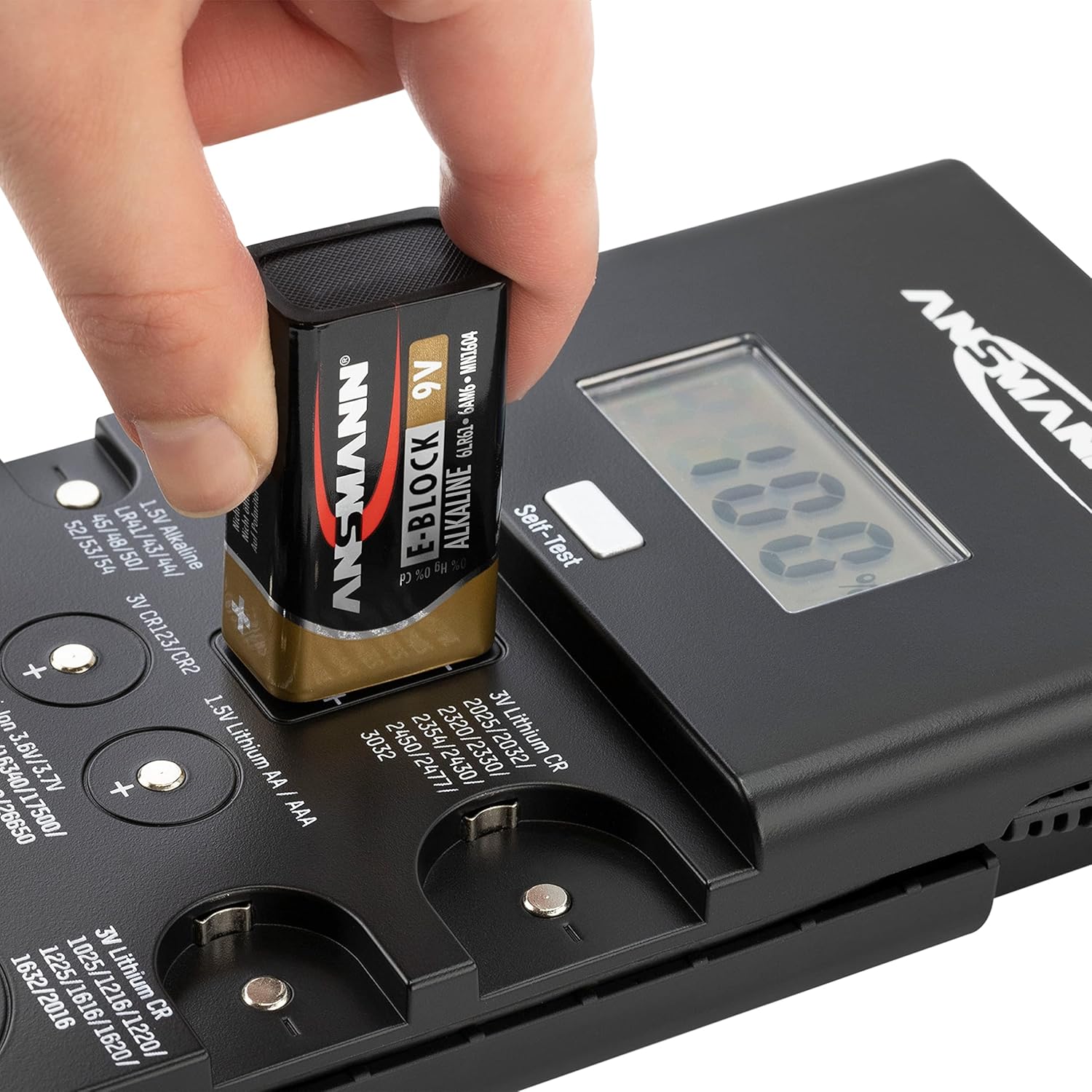
Figure 2: Inserting the 9V battery into the tester. This image demonstrates the correct way to insert the 9V battery that powers the Ansmann Energy Check LCD.
Mode d'emploi
Fonctionnement général
The Ansmann Energy Check LCD provides quick and easy battery testing. The device automatically detects the battery type and displays the energy content in 10% steps and the voltage in volts (V) within 2-3 seconds.

Figure 3: Fast Testing and Percentage Display. This image highlights the quick testing capability and the 10% step display of the battery's energy content.
Battery Type Identification and Testing Slots
The tester features multiple dedicated slots and a test probe for various battery types. Refer to the diagram below to identify the correct testing location for your battery.

Figure 4: Battery Type Testing Slots. This detailed diagram illustrates where each specific battery type should be placed or connected for accurate testing.
Procédure de test
Pour tester une batterie :
- Identify the correct slot or contact points for your battery type using Figure 4.
- Ensure the battery terminals are clean and free of debris.
- Place the battery firmly into the designated slot or press it against the contact points, observing correct polarity (+ and -). For batteries requiring the test probe, connect the probe to the battery's positive terminal and the negative terminal to the corresponding contact on the tester.
- The LCD display will show the battery's energy content in percentage and its voltage.

Figure 5: Testing a Button Cell Battery. This image shows a user testing a small button cell battery by pressing it onto the designated contact points.

Figure 6: Testing an AA Battery with Probe. This image illustrates the use of the test probe for larger cylindrical batteries like AA or AAA.
Entretien
Nettoyage
To ensure accurate readings and prolong the life of your tester, keep it clean. Wipe the exterior with a soft, dry cloth. Periodically clean the metal contact surfaces with a cotton swab lightly dampened with rubbing alcohol to remove any residue that might affect conductivity.
Stockage
Store the Ansmann Energy Check LCD in a cool, dry place away from direct sunlight and extreme temperatures. If the tester will not be used for an extended period, it is recommended to remove the 9V battery to prevent leakage.
Dépannage
- Le testeur ne s'allume pas :
Check if the 9V battery is correctly inserted with the proper polarity. Ensure the 9V battery itself has sufficient charge. Replace if necessary.
- Lectures inexactes ou incohérentes :
Ensure the battery being tested is making firm and clean contact with the tester's terminals. Clean the battery terminals and the tester's contact points if there is any visible dirt or corrosion. Ensure the battery is placed in the correct slot for its type.
- Display shows 'LO' or 'ERR':
This may indicate a very low battery charge or an incompatible battery type. Verify the battery type is supported by the tester.
Caractéristiques
| Fonctionnalité | Spécification |
|---|---|
| Numéro de modèle | 1900-0100 |
| Dimensions du produit | 3.94 x 1.26 x 7.68 pouces |
| Poids de l'article | 9.63 once (273 grammes) |
| Source d'énergie | 1 batterie 9 V (incluse) |
| Couleur | Noir |
| Affichage de la mesure | Energy content in 10% steps, Voltage in Volts (V) |
Types de batteries pris en charge
- 3V Lithium Button Cells: CR1025, CR1216, CR1220, CR1616, CR1620, CR1632, CR2016, CR2025, CR2032, CR2320, CR2330, CR2354, CR2430, CR2450, CR2477, CR3032
- 3V Lithium Photo Batteries: CR2, CR123(A)
- 1.5V Alkaline Button Cells: LR41, LR43, LR44, LR45, LR48, LR50, LR52, LR53, LR54, LR55, LR57, LR58, LR59, LR60, LR63, LR66, LR69
- 1.44V Zinc-Air Button Batteries: 10, 13, 675, 312
- 12V Alkaline Batteries: A23, A27
- 1.5V Alkaline Batteries: AAA, AA, C, D, 9V alkaline battery
- 1.2V NiMH/NiCd Batteries: AAA, AA, C, D
- Piles au lithium 1.5 V : AAA, AA
- 3.6V/3.7V Li-ion Batteries: 14500, 14650, 16340, 17500, 18500, 18650, 22650, 26650
Consignes de sécurité
Please observe the following safety guidelines when handling batteries and using the Ansmann Energy Check LCD:

Figure 7: Battery Safety Icons. This image displays universal symbols for safe battery handling, including warnings against improper disposal, short-circuiting, heating, and disassembling batteries.
- Do not attempt to test damaged or leaking batteries.
- Ne court-circuitez pas les bornes de la batterie.
- Ne jetez pas les piles au feu.
- Ne démontez pas les piles.
- Gardez les piles hors de portée des enfants.
- Jetez les piles conformément aux réglementations locales.
Garantie et assistance
For detailed warranty information, technical support, or service inquiries regarding your Ansmann Energy Check LCD, please visit the official Ansmann webConsultez leur site web ou contactez leur service client. Conservez votre reçu d'achat comme preuve d'achat pour toute réclamation au titre de la garantie.
Vous trouverez plus d'informations sur le site web. Ansmann Store on Amazon.