
1. Introduction
This manual provides essential instructions for the installation, operation, and maintenance of your Oceanic Commercial Grade Reverse Osmosis + Deionization (RO/DI) Water Filtration System. This system is designed to produce ultra-pure water for various commercial applications by effectively removing dissolved solids and contaminants. Please read this manual thoroughly before operating the system to ensure proper function and longevity.

Image: The Oceanic Commercial Grade RO/DI Water Filtration System, showcasing its robust design and components.
2. Produit terminéview
The Oceanic Commercial Grade RO/DI system combines high-efficiency reverse osmosis membranes with deionization technology to produce up to 600 gallons of filtered water per day. This system is engineered for commercial applications requiring high volumes of purified water, effectively removing chlorine, hardness, heavy metals, toxins, and other water impurities.
Caractéristiques principales :
- Commercial Sized Capacity: Provides hundreds of gallons per day (GPD) of clean, ultra-pure water.
- High Contaminant Removal: Thoroughly tested and proven to remove 99% of contaminants and impurities for perfect 0 TDS water.
- Integrated Booster Pump: Increases purified water production by optimizing water pressure for the reverse osmosis process.
- Oversized Pre-filters: Features 20-inch pre-filters with double the capacity of standard 10-inch filters, reducing the frequency of filter changes in heavy-use environments.
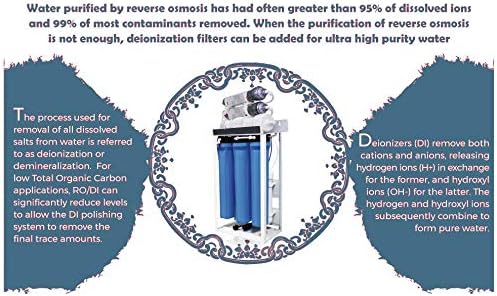
Image: Explanation of Reverse Osmosis and Deionization processes, highlighting their effectiveness in removing dissolved ions and contaminants for ultra-high purity water.
3. Applications
This RO/DI system is suitable for a wide range of commercial and specialized applications requiring high-purity water, including:
- Aquariums and large tanks
- Installations de fabrication
- Centres commerciaux
- Hôtels
- Laboratoires
- Pet shops
- Marine research
- Pharmaceutical applications
- Établissements d'enseignement
- Organismes gouvernementaux
4. Filtration Stages
Le système utilise un système multi-stage filtration process to ensure optimal water purity:
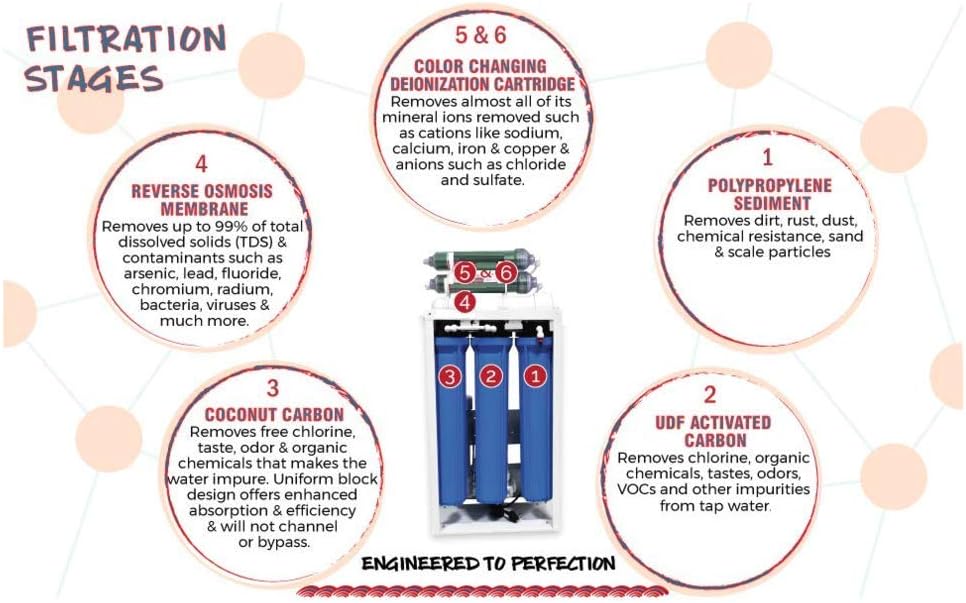
Image: Diagram illustrating the six filtration stages of the RO/DI system, from sediment and carbon pre-filters to reverse osmosis membranes and deionization cartridges.
- Polypropylene Sediment Filter: Removes dirt, rust, dust, chemical resistance, sand, and scale particles.
- UDF Activated Carbon Filter: Removes chlorine, organic chemicals, tastes, odors, VOCs, and other impurities from tap water.
- Coconut Carbon Filter: Removes free chlorine, taste, odor, and organic chemicals that make water impure. Uniform block design enhances absorption and efficiency.
- Membrane d'osmose inverse : Removes up to 99% of total dissolved solids (TDS) and contaminants such as arsenic, lead, fluoride, chromium, radium, bacteria, viruses, and more.
- Color Changing Deionization Cartridge (Stage 5 & 6): Removes almost all remaining mineral ions such as sodium, calcium, iron, copper (cations) and chloride, sulfate (anions) for ultra-pure water.
5. Configuration et installation
Proper installation is crucial for the optimal performance of your RO/DI system. It is recommended that installation be performed by a qualified professional. Refer to the flow chart below for a visual guide to the system's connections.
Étapes générales d'installation :
- Déballer les composants : Retirez soigneusement tous les composants de leur emballage et vérifiez qu'ils ne sont pas endommagés.
- Mount System: Securely mount the main filtration unit in a suitable location, ensuring easy access for maintenance.
- Raccordement de l'arrivée d'eau : Connect the source water line to the system's inlet. Ensure all connections are tight to prevent leaks.
- Connectez la conduite de vidange : Connect the drain line from the flow restrictor to a suitable drain.
- Connect Pure Water Outlet: Connect the purified water outlet to your desired storage tank or dispensing point.
- Connexion électrique : Connect the booster pump to a grounded electrical outlet.
- Système de chasse d'eau : Avant la première utilisation, rincez le système conformément aux instructions d'utilisation afin d'éliminer tout résidu de fabrication.
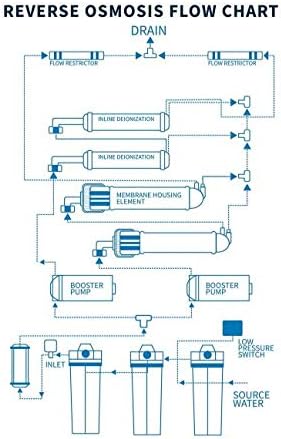
Image: Detailed flow chart illustrating the path of water through the Reverse Osmosis and Deionization system, including inlet, pre-filters, booster pump, membrane housing, deionization cartridges, and drain.
6. Fonctionnement
Démarrage initial:
- Ensure all connections are secure and the system is properly mounted.
- Slowly turn on the source water supply to the system. Check for leaks.
- Plug in the booster pump. The pump will activate to increase water pressure.
- Allow the system to run for several hours (refer to specific flushing instructions for your model) to flush out air and carbon fines. Discard the initial purified water.
- Monitor the TDS (Total Dissolved Solids) of the purified water. A properly functioning RO/DI system should produce water with 0 TDS.
Fonction de la pompe d'appoint:
The integrated booster pump is designed to elevate the incoming water pressure to the optimal level for the reverse osmosis membranes. This action significantly increases the system's production rate and improves the efficiency of the pure water to drain water ratio. The pump will automatically engage when water flow is detected and disengage when the system is off or when the low-pressure switch is activated (if applicable).
Flow Rate Considerations:
The stated flow rates (e.g., 600 GPD) are based on a water temperature of 77°F (25°C). Water temperature directly impacts the flow rate:
- For every degree Fahrenheit the temperature lowers, approximately 3% of product flow is lost.
- For every degree Fahrenheit the temperature increases, approximately 3% of product flow rate is gained.
This occurs because higher temperature water has lower viscosity and a higher diffusion rate, allowing it to permeate the RO membrane more easily. Expect a decrease in flow rate during colder seasons.
7. Entretien
Regular maintenance ensures the continued high performance and longevity of your RO/DI system.
Calendrier de remplacement du filtre :
- Préfiltres à sédiments et à charbon (Stages 1, 2, 3): Replace every 6-12 months, or sooner if water pressure drops significantly or taste/odor issues arise. The 20-inch oversized filters extend this interval compared to standard 10-inch filters.
- RO Membranes (Staget 4) : Replace every 2-5 years, depending on source water quality and usage. Monitor TDS levels; an increase in purified water TDS indicates membrane degradation.
- Deionization (DI) Cartridges (Stages 5 & 6): Replace when the color-changing resin indicates exhaustion, or when the purified water TDS rises above 0. The lifespan varies greatly depending on the TDS of the RO water entering the DI stage.
Soins généraux:
- Regularly inspect all tubing and connections for leaks.
- Keep the system area clean and free from debris.
- Ensure adequate ventilation around the system.
- Do not expose the system to freezing temperatures, as this can damage components.
8. Dépannage
| Problème | Cause possible | Solution |
|---|---|---|
| Faible production d'eau |
|
|
| High TDS in Purified Water |
|
|
| Fuites d'eau |
|
|
| Booster Pump Not Running |
|
|
9. Spécifications
- Marque: Océanique
- Modèle: 600 GPD Commercial Grade RO/DI System
- Méthode de purification : Reverse Osmosis, Deionization
- Capacité: 600 gallons par jour (GPD)
- Matériel: Polypropylène
- Poids de l'article : 65 livres
- Dossier spécial : Chlorine Reduction, Multi Stage Filtration, Built-in Booster Pump
- Fabricant: Systèmes d'eau océaniques
- ASIN: B07P2QCBFW
- Code à barres : 818368017413
- Date de mise en ligne sur Amazon : 23 février 2019
10. Garantie et assistance
For warranty information, technical support, or to order replacement parts, please contact Oceanic Water Systems directly. Refer to your purchase documentation for specific warranty terms and contact details.
Vous trouverez souvent des informations d'assistance sur le site officiel du fabricant. websur le site ou auprès de votre point de vente initial.